Pinocchio’s Schoolbook
The Adventures of PinocchioPinocchio’s Schoolbook is the primer Geppetto buys for his son by selling his own coat. It embodies a hard-won chance for Pinocchio to begin school, but Pinocchio parts with it almost at once to pursue entertainment. Later, in a fight by the sea, schoolbooks become missiles, and a prized arithmetic volume strikes a boy. Across these episodes, books shift from the means of education to the cost of an impulsive choice and, finally, to objects caught up in violence.
The Primer and Its Purchase
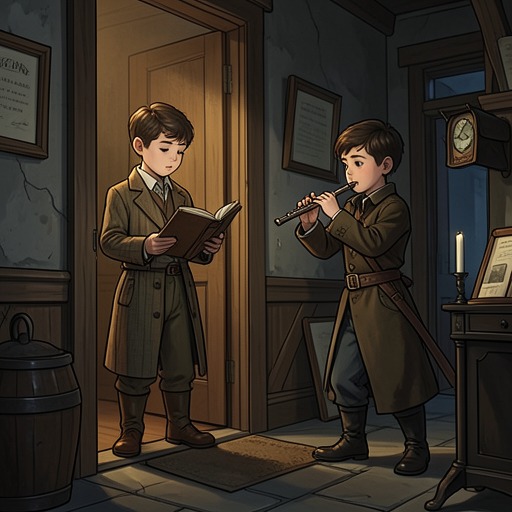
Pinocchio identifies an A-B-C book as the essential thing still needed for him to go to school. The request makes education concrete: it is not just a promise or an abstract intention, but an object that has to be obtained. When Geppetto asks how they will manage it, Pinocchio suggests going to a bookstore. The plan falters when they realize they do not have the money.
Pinocchio grows sad at the reminder of their poverty. Geppetto, however, rises, puts on his old coat, and leaves without another word. He returns with the book in his hands and without the coat. He has sold it; he is left in his shirt sleeves on a cold day. The purchase therefore carries a visible cost borne by the father, while the book itself becomes the material sign of his effort to make schooling possible for his son.
Sold Before School
Pinocchio soon reaches the point of selling the book. He first tries to exchange it for a cap, but the proposed bargain is worthless to him; he then offers the book for four pennies. A boy refuses to buy from another boy, but a ragpicker offers the same sum, and the book changes hands. Pinocchio is seeking money to enter the Marionette Theater, and the sale enables him to follow that desire instead of keeping the object his father sacrificed to provide.
The exchange is sharpened by the narrator’s reminder that Geppetto is at home, cold and shivering, unaware that the book he bought for his son has been sold. The contrast does not depend on the book being damaged or lost accidentally: Pinocchio deliberately gives it up, and the father’s sacrifice remains in force after the object has passed to someone else. The primer thus links an act of parental care to a choice that immediately frustrates its purpose. Pinocchio has the means to attend school, but chooses the theater instead.
From Schooling to Conflict
Later, Pinocchio is again among schoolbooks, but the circumstances have changed. During a fight with other boys, books are thrown at him and pass over his head into the sea. Fish rise to investigate the pages, taste them, and spit them out. The scene turns the books into comic, ineffective projectiles, while also making their ordinary educational purpose conspicuously absent: in the brawl, they are ammunition rather than reading material.
When the boys run out of their own books, they seize Pinocchio’s bundle. One takes a very large, leather-bound arithmetic text, which Pinocchio particularly values among his books, and throws it at Pinocchio. It misses him and hits another boy, Eugene, who falls senseless. The episode does not identify that arithmetic volume as the A-B-C book sold earlier; it presents it as a distinct book in Pinocchio’s later bundle. Its importance lies in the reversal: a book associated with schooling and prized by its owner becomes an instrument of injury in a fight.
Regret and Recurring Meaning
After the other boys flee, Pinocchio stays beside Eugene, wets a handkerchief in the sea, and tries to bathe the injured boy’s head. He weeps, fears what will happen when he goes home, and regrets having listened to his companions instead of going to school. His distress makes the earlier sale part of a recurring pattern: the schoolbook he once exchanged for the theater and the later books swept into a fight both stand against the schooling he repeatedly fails to choose.
The books do not independently determine Pinocchio’s conduct. Their significance comes from the uses to which he and those around him put them: the primer is bought through Geppetto’s sacrifice and sold for immediate pleasure; the schoolbooks at the shore are thrown, scattered into the sea, and used as weapons. The changing role of the object gives material form to the conflict between schooling and distraction, and between the possibility of learning and the consequences of acting with bad companions.